
AI video analysis for competitive dance and cheer
See exactly what the judges see.
Upload a routine from your phone. RoutineX scores it like a competition panel in minutes — and Spotlight breaks one dancer down frame by frame, with the corrections drawn on her.

- “slay”Dancer, after her report
- “I really love the idea of this product — something I’ve been looking for.”Stephanie F., dance parent
- “I truly appreciate that you built this from the eye of a parent and protecting the privacy of children.”Stephanie F., dance parent
- “Thank you so much! I am adding my review in now!”Jana R., dance parent
- “5.0 on the App Store”RoutineX: Dance & Cheer AI
- “slay”Dancer, after her report
- “I really love the idea of this product — something I’ve been looking for.”Stephanie F., dance parent
- “I truly appreciate that you built this from the eye of a parent and protecting the privacy of children.”Stephanie F., dance parent
- “Thank you so much! I am adding my review in now!”Jana R., dance parent
- “5.0 on the App Store”RoutineX: Dance & Cheer AI
Two ways in
Score the routine. Or put one dancer under the light.

The whole routine
The routine
RoutineX scoring
Three simulated judges score the whole routine on a 300-point competition rubric — technique, performance, choreography, overall — with timestamped notes and a priority list. Solos, groups, cheer. Results in minutes.
- First analysis
- 99¢
- Then
- $1.99 or $4.99/mo for 4

One dancer
One dancer
RoutineX Spotlight
Sixty to eighty frames of her routine, tracked on your phone. The moments a coach would freeze on, with the lines, angles and corrections drawn on her own frames. Priorities, drills, a four-week plan. A PDF you can hand to her teacher.
- One dancer, one routine
- $14.99
- A private lesson
- $75–150
RoutineX Spotlight
Coaching, drawn on her.
Every angle on these frames is measured from the dancer's own body. Gold marks what is working. Pink marks what to change. The dashed line is where the line should be.
- 12–16 key moments, chosen from 60–80 tracked frames
- The corrected limb drawn beside hers, so she sees the difference
- Seven category scores and how it reads on a judge's card
- Priorities with the cause, drills with sets, reps and a cue
- Competition-day cues, a four-week plan, a PDF for her teacher
Frames shown are generated stage photographs run through the same tracker — no real dancer appears on this site.
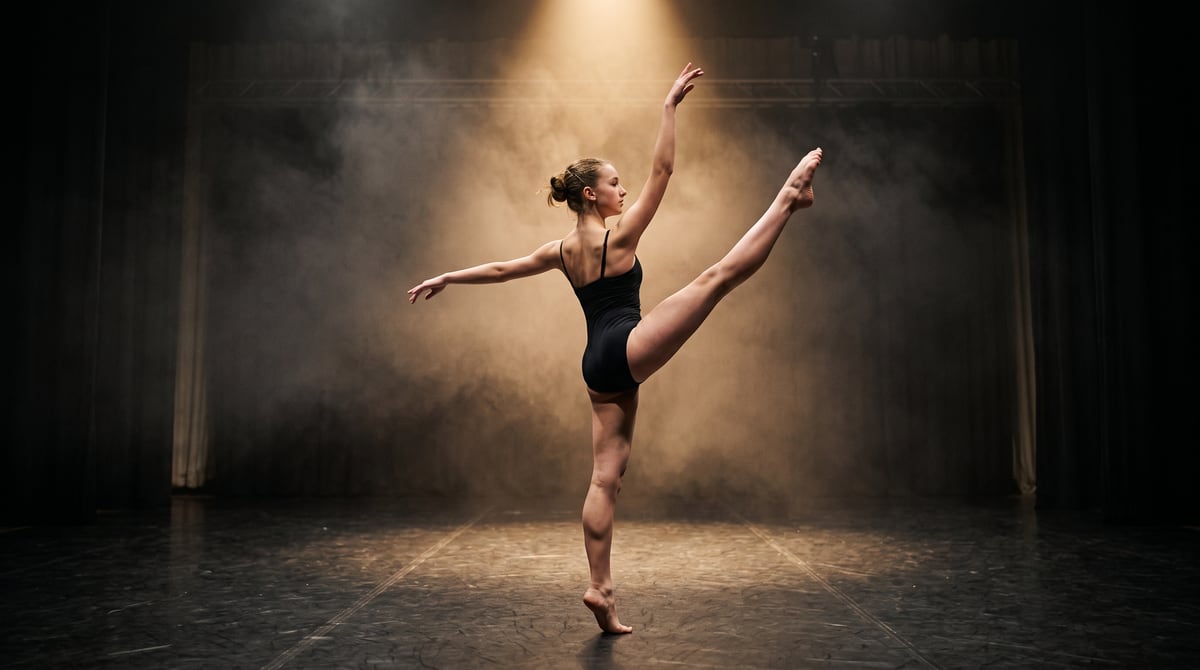
The working leg reads 150° from vertical — well above the hip line, which is what the judges reward. The supporting knee is locked at 176°. The one note: the working knee is 171°, not quite straight, so the line stops two inches short of where the foot could be.
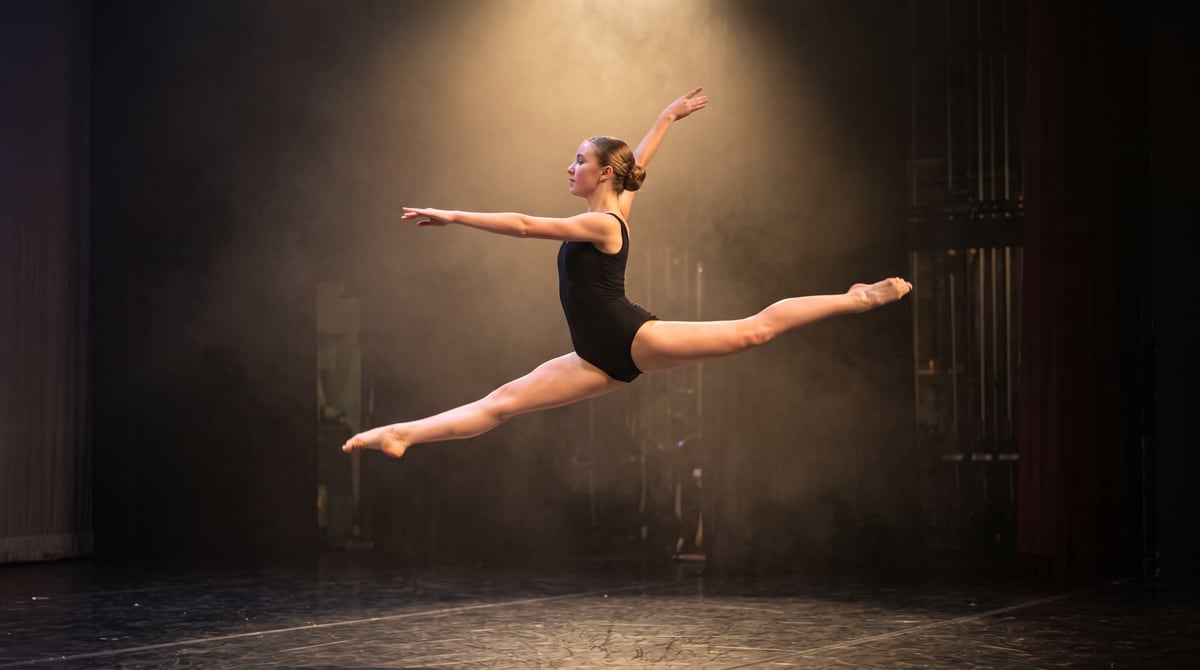
A 169° split in the air with the front leg straight at 176°. The back knee is 164°: it is the first thing a judge sees from the side, and straightening it is worth more than any extra inch of height. The ghost line shows where that back leg sits when the knee finishes.
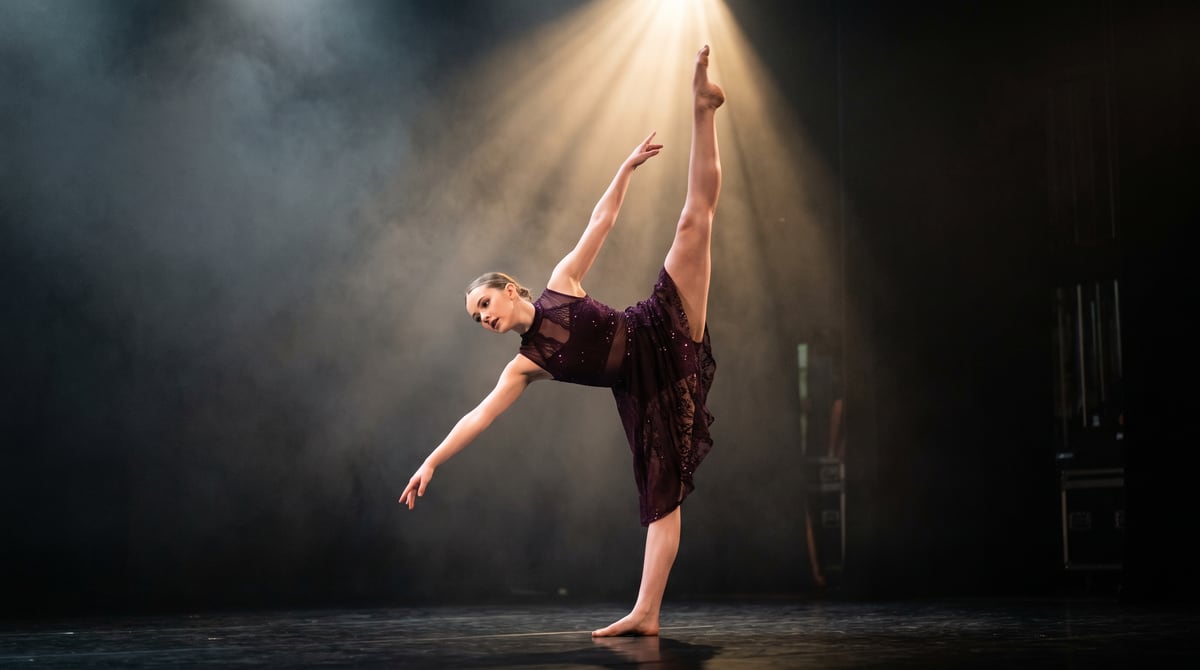
The kicking leg reads 175° from vertical with both knees locked at 176° — this is a line the judges score. The torso tips 64° to make room for it, which is the trade a tilt asks for; the arm on the lifted side stays long through the fingertips. Nothing to fix here. This is the frame to put on the fridge.
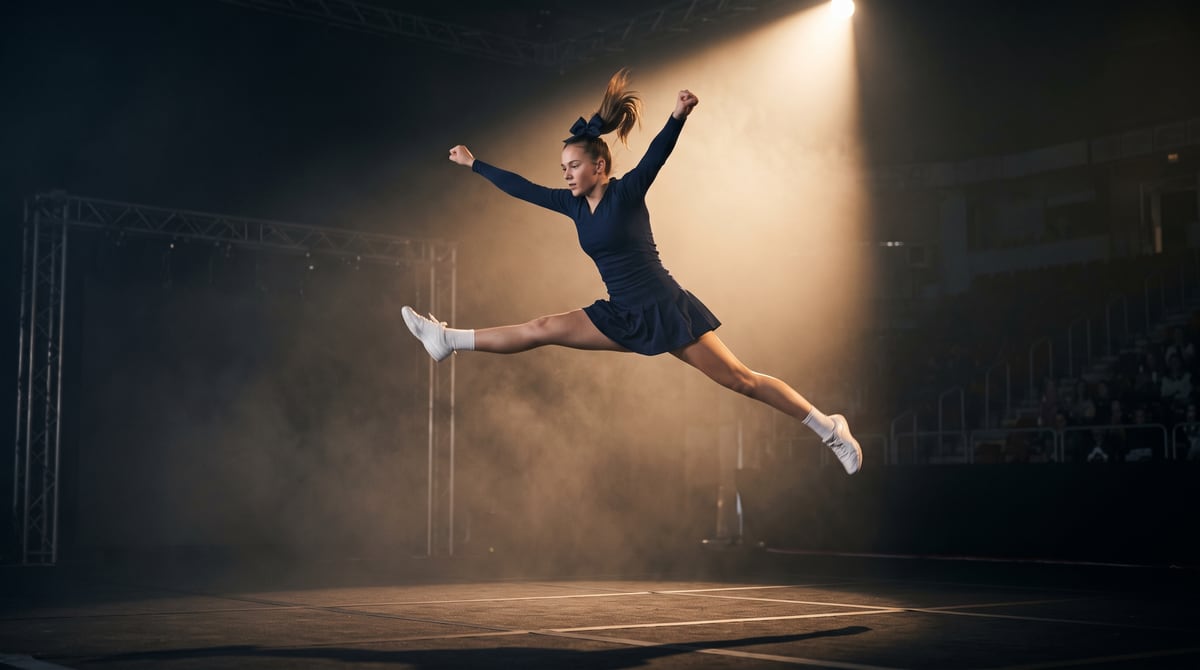
The lead leg is at 79° from vertical and the knees are 166° and 175° — the judges will see the softer knee first. The chest stays up (13° of lean, which is the goal: hips roll under, chest doesn't drop) and the arms hold a clean V. The corrected line shows the lead leg with the knee finished and two more degrees of lift.
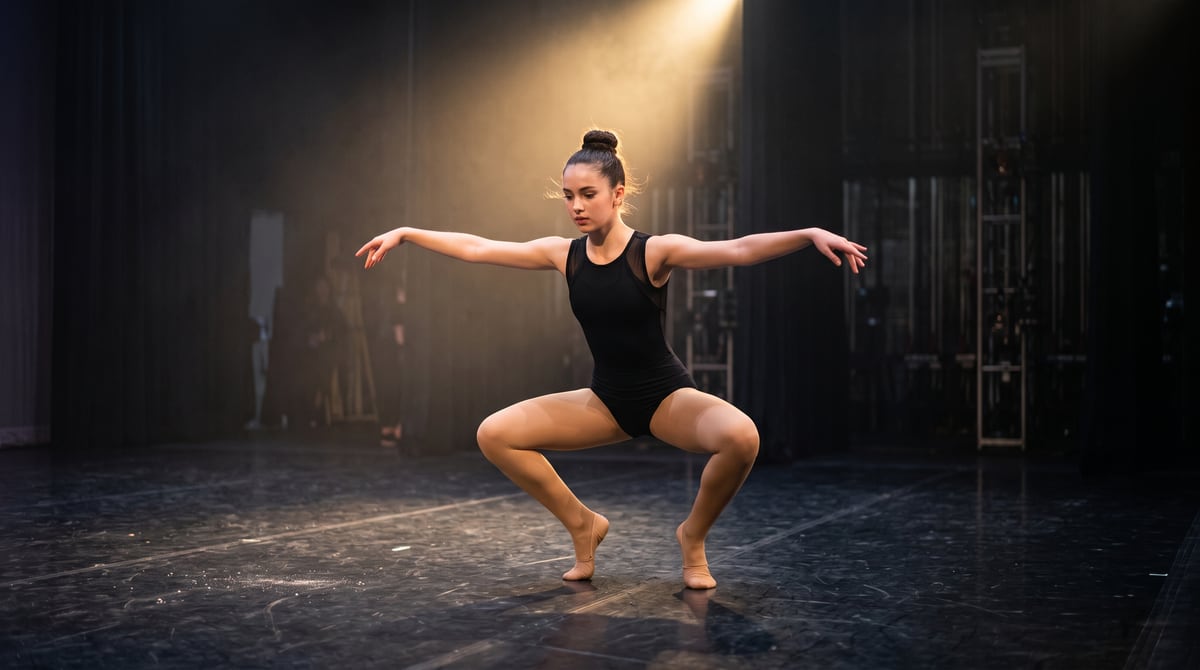
This is the frame judges watch hardest and parents never film. The knees are 117° and 90° — the right side is taking more of the landing, which is why one hip reads lower than the other. Shoulders are level (within 2°) and the arms are held, which saves the picture. The fix is in the preparation, not the landing: equal push off both feet.
How a Spotlight report is made
Two to three minutes. The most thorough look she can get.
- 1
Upload from your phone
Any routine video — a studio run-through, last weekend's comp, a living-room take. Group video? Tap your dancer on the first frame and we follow her through the routine. Everyone else is blurred before anything leaves the phone.
- 2
Every frame gets measured
Sixty to eighty frames are tracked on your device: knees, hips, shoulders, lines, lean, balance. From those we pick the moments a coach would freeze on — the apex of the jump, the top of the extension, the landing, the turn.
- 3
A coach writes it up
What is working and why it scores. What to change, with the cause behind it. The marks drawn on her frames, drills with cues, a four-week plan. Two to three minutes later it is on your screen and in your inbox as a PDF.
Pricing
Less than one private lesson. Notes that last all season.
RoutineX Spotlight
- 60–80 frames tracked on your phone
- 12–16 key moments with lines, angles and corrections drawn on her
- The corrected limb drawn beside hers, so she sees the difference
- Seven category scores, plus how it reads on a judge's card
- Priorities with the cause, drills with cues, competition-day cues, a four-week plan
- Web report plus a PDF for her teacher
- Group videos: tap your dancer, everyone else is blurred
One-time. Money-back guarantee.
Routine scoring
First analysis
One-time welcome price. The full three-judge sheet.
Single analysis
Any routine, any time. Credits never expire.
Season Member
4 analyses a month, season tracker, practice plans included. Cancel anytime.
Competition Pack
5 analyses. Credits never expire.
Studios: RoutineX Studio, $99/mo with a 30-day free trial.
Privacy
Your child's privacy isn't an afterthought.
- The video never leaves your phone
- Frames are pulled from the video on your device. The file itself is never uploaded, to us or anyone.
- Other dancers are blurred before upload
- In a group video you tap your dancer. Everyone else is blurred on your phone, before a single frame is sent.
- Nobody watches
- No human reviews your frames. Routine-scoring frames are deleted within 24 hours. Spotlight keeps only the frames in your report, and you can delete the whole report with one tap.
- Built by a dance parent
- RoutineX was built by a competitive-dance family for competitive-dance families. The founder answers the support email himself.
Questions
Things families ask before they upload.
What is RoutineX Spotlight?
A private, in-depth technique breakdown of one dancer. We track 60–80 frames of her routine on your phone, pick the moments a coach would freeze on, measure the lines and angles on her own body, and write it up like a private session: what is working, what to change and why, drills with cues, and a four-week plan. You get it on the web and as a PDF. $14.99, one-time.
How is Spotlight different from routine scoring?
Routine scoring judges the whole routine the way a competition panel does — a score out of 300, an award level, timestamped notes. Spotlight is about one dancer's technique, frame by frame, with the corrections drawn directly on her frames. Most families use scoring all season and Spotlight before a big competition or when something specific needs fixing.
Does it work on group routines?
Yes. Upload the group video, tap your dancer on the first frame, and we follow her through the routine. Everyone else is blurred on your phone before any frame is uploaded.
Are the angles real?
Yes. Every number on a Spotlight report is measured from the frames with on-device pose tracking. The coach decides what to point at; the geometry comes from her body, not from a description. Angles are measured from the camera's point of view, so trends across moments matter more than any single degree.
How long does it take?
Routine scoring: usually one to three minutes. Spotlight: two to three minutes, because it tracks and measures every frame before the write-up. You can close the tab — the PDF lands in your inbox.
What does it cost?
Your first routine analysis is 99¢. After that it is $1.99 each, or $4.99 a month for four as a Season Member. Spotlight is $14.99 per dancer per routine. Studios have their own plan with a 30-day free trial.
What happens to the video?
It never leaves your phone. Still frames are extracted on your device and only those are sent. Scoring frames are deleted within 24 hours. Spotlight keeps the frames used in your report so you can reopen it, and you can delete the report and its frames any time.
What if the report misses the mark?
Email us what was off and we credit your account. The founder answers those emails himself.